When it comes to hydration, water isn’t the only important thing to focus on. You need electrolytes too! Sodium is an essential electrolyte that plays a crucial role in maintaining good health and hydration. Despite its reputation as a contributor to high blood pressure and heart disease, sodium actually helps regulate fluid balance, transmit nerve impulses, and contract and relax muscle fibers.
Why is sodium important for hydration?
Sodium helps regulate fluid balance by attracting and retaining water in the body. When you sweat, you lose sodium and other electrolytes, which can lead to dehydration. Replenishing sodium through your diet or by drinking sports drinks or electrolyte-enhanced water can help prevent dehydration and support optimal hydration.
How much sodium should you consume around exercise?
The amount of sodium you need around exercise depends on several factors. This includes your level of physical activity, the duration and intensity of your workout, and the environmental conditions, such as temperature and humidity. In general, most people need 500-700mg per hour of exercise. If you’re unsure about how much sodium you need, consult with a healthcare provider or a registered dietitian for personalized advice.
Staying hydrated is crucial for good health and fitness, but finding the right way to replenish your body’s fluids can be challenging. From sports drinks loaded with sugar to plain water that lacks essential electrolytes, there are many options on the market, but not all of them provide the optimal balance of hydration and nutrients your body needs.
That’s where LMNT hydration packets come in.
What are LMNT hydration packets?
LMNT makes hydration packets that you can mix with water. Each packet contains a blend of electrolytes, including sodium, potassium, magnesium, and calcium, as well as other vitamins and minerals, such as Vitamin C and B6.
The benefits of LMNT hydration packets
Optimal hydration: LMNT hydration packets provide a balanced combination of electrolytes and other nutrients that help you stay hydrated and replenish what your body loses through sweating, physical activity, and other activities.
Convenient: LMNT hydration packets are easy to use and can be taken with you anywhere, so you can stay hydrated on the go.
Customizable flavor: LMNT offers a variety of flavors to choose from, so you can find the one that best suits your taste.
Affordable: LMNT hydration packets are an affordable option compared to other sports drinks on the market, and provide a more balanced and nutrient-rich way to stay hydrated.
LMNT hydration packets provide a convenient and affordable way to stay hydrated, while providing essential nutrients and electrolytes to support optimal health and fitness. Whether you’re a professional athlete, a busy parent, or simply someone who wants to stay hydrated, LMNT hydration packets are a great option to consider. Try one next time you’re in the gym!
There is more to your health than just working out! Your coaches want you to prioritize all aspects of your wellness, not just getting a good sweat in.
Our wellness has various pillars: physical, emotional, social, spiritual, financial, environmental, and intellectual/occupational. If you think of these pillars as the foundation to your health, you can visualize what a strong foundation looks like. This means all areas of your wellness are being accounted for! However, if one pillar is lacking-the whole foundation can crumble.
Here are the top ways I take care of each pillar. Remember there are many ways to take care of each pillar of your wellness, but this is just a condensed list of my go-to methods. After reading this list, hopefully it gives you some new ideas to try!
Physical- I make time for my own workouts in my schedule and choose movement that makes me feel good and empowered. I prioritize rest and recovery days to ensure my body is not overworked. I love to make new recipes and enjoy food with those I love to fuel my body.
Emotional- I talk about how I am feeling and put words to my emotions with someone I trust. I make time to decompress to ensure I don’t get overwhelmed daily and I allow myself to feel whatever emotions come my way.
Social- I make time for friends and family to ensure I get to spend quality time with them. Each month I make sure I do things I love (like seeing live music or trying a new restaurant).
Spiritual- I practice affirmations daily to start my day on a grounded note. I practice mindfulness, yoga, and breathing techniques.
Financial- I meal prep weekly to ensure I don’t overspend on takeout. I “treat myself” on special things I love, but I also create a budget sheet to ensure I am being fiscally responsible.
Environmental-I spend free time working on my garden, which allows me to feel more connected with the earth around me. I love to get outside for a run or hike! On top of this, everyday I take care of the space around me at home to make sure I have an environment that is clean, organized, and brings me joy.
Intellectual/Occupational- I read and participate in continuing education to allow myself to continue to grow in my profession and intellectually.
As I said, this is a small list of just some of the things I do. If you aren’t feeling 100% in your health journey, take time to reflect on how you care for each pillar of your wellness. It can be eye opening! Maybe you’ll notice an area you neglect, maybe you’ll notice an area you put a little too much of your energy into.
Practice balance in each pillar and you will see your health improve. Do you have favorite ways to take care of yourself? We’d love to hear it!
There’s no denying that nutrition plays a key role in accelerating your progress in and out of the gym. If you’ve been working out for a while and aren’t seeing the progress you have been aiming for, it may be time to reflect on other areas of your wellness. There are many factors of your wellness that could impact progress such as stress, sleep, and more. But today, we’ll hone in on nutrition. Your nutrition does not have to be complicated and if you are searching for some new goals to aim for; this blog is for you.
Before diving into the specifics of nutrition during training blocks, it is important to have a basic understanding of macronutrients and what they do for our body.
The Basics
Why do macronutrients matter?
Macronutrients provide so many health benefits for our bodies! These are the nutrients we eat the most of, hence the name “macro”. It is important to eat a mix of all macronutrients at each meal, as each macronutrient serves a specific purpose for the body.
Here’s a quick rundown of the health benefits of each macronutrient:
Proteinhelps repair and rebuild cells, promotes muscle growth and recovery, aids in keeping us full and satiated, and supports so many other bodily functions. Protein takes longer to digest, when compared to carbohydrates, so is a key macronutrient when trying to improve your nutrition to help you feel satisfied throughout the day.
Fats are an essential part of our diet and provide us with many health benefits. Fats allow your body to absorb fat soluble vitamins (A,D,E, & K), provide necessary energy, protect organs, promote proper hormones, build cells, and more. Not only do they provide us with these wonderful benefits, they also make food a lot more enjoyable and tasty!
Carbsprovide our bodies with energy in the form of glucose! They are rich in micronutrients, fiber, and are the body’s preferred energy source. They provide fuel for the brain and all organs of the body.
General Guidelines
When it comes to nutrition around a workout, we want you to feel fueled and energized. On social media or other platforms, you may see information regarding the specific times you should be eating your food. This is called “nutrient timing”.
Nutrient timing is nuanced… we wouldn’t say its “good” or “bad”, it just depends on the context. If you are working out as a hobby, you generally don’t have to worry about perfect nutrient timing. While nutrient timing has been heavily marketed by influencers and supplement companies, the overall intake of your nutrients is more important. What matters most is getting your carbs, fats, and protein in each day and if you miss a post workout shake… it will all be okay.
Below are general guidelines of what to eat surrounding your workout.
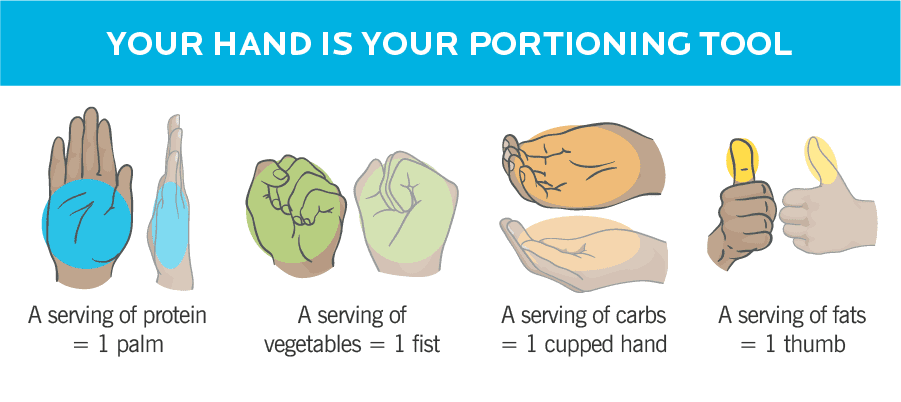
The above photo is from Precision Nutrition.
Working out first thing in the morning.
When working out without food in your body first thing in the morning, we recommended to at least drink a protein shake or glass of milk before your workout. A good rule of thumb would be to get a serving of protein (ex: protein shake) before your workout, then eat a balanced meal within 1-2 hours (1-2 palm sized servings of protein, 1-2 cupped handfuls of carbs, 1 fist of veggies, 1 thumb of fat) after your workout.
Training after you’ve already eaten during the day, and 2-3 Hours Before a Workout
A good rule of thumb when eating a few hours from a workout is to eat a well-balanced, mixed macronutrient meal. This would be 1-2 palm sized servings of protein, 1-2 cupped handfuls of carbs, 1-2 fist of veggies and 1-2 thumbs of fat depending on your needs.
1 Hour or Less Before a Workout
When eating close to a workout you may want to opt for lower fats, fast digesting carbs, and quality protein. We love to make smoothies and shakes, simply because we find it easier to digest! Want to know our favorite smoothie recipes? Click here.
If you’re not a smoothie fan, no biggie. Just opt for something you know you digest well! Lower fiber options usually work well for most people. You don’t want an upset stomach before having to train.
For some people, higher fats before a workout can cause GI distress (aka triggering upset stomach and bowel movements). If this is you, limit your fats pre workout. No one wants GI issues while trying to do box jumps!!
After a Workout
1-2 hours after your workout, it is great to take the same approach you did pre workout! Depending on your needs, aim for 1-2 palm sized servings of protein, 1-2 cupped handfuls of carbs, 1-2 fists veggies, 1-2 thumbs of fat.
Nutrition Needs During Training Blocks
If you train at Paragon, you know we cycle through three training blocks: hypertrophy, strength, and work capacity. Each of these training blocks have different demands on the body, which means your nutritional needs can slightly change depending on the training style you are completing. First, let’s define these three training blocks:
Hypertrophy: The focus is on building muscle size and increasing muscle mass. These workouts are high-volume, moderate-to-high-intensity, and include a wide variety of exercises.
Strength: The goal here is to increase your body’s ability to generate force. These workouts are low-volume, high intensity, and have a smaller exercise selection (when compared to hypertrophy and work capacity).
Work Capacity: The goal is to increase your body’s ability to handle work, improve recovery, and push past plateaus in your training.
Hypertrophy
Your muscles are undergoing a lot of stress during this training block! While all of the recommendations above are important, you can hone in on quality protein during hypertrophy. Here are our favorites:
Greek yogurt. Add some honey and fruit to your yogurt for the perfect snack.
Eggs. Bonus points: mix in cottage cheese into your scrambled eggs for an added protein boost.
Ground meat. Saute this up with some veggies and add to a bowl of rice. Simple and delicious.
Tofu. Bake this with your favorite marinade or seasonings for a plant-based protein.
During a strength block, you’ll want to make sure you’re eating enough surrounding your workouts. Focus on a good meal of easily digestible carbs and a protein source before + after the gym. Here are our favorite pre and post workout meals/snacks:
Oatmeal mixed with a scoop of protein powder. Add some berries on top and you’re set!
Shredded chicken, veggies, and rice. Top with your favorite salsa.
Baked tofu, potatoes, and veggies. Add some hot sauce for a flavor kick!
Rice cakes and greek yogurt.
Banana and protein bar.
Work Capacity
Your carbohydrate needs will go up during a work capacity block! If you have found yourself craving carbs during this block, your body is telling you something. Don’t be afraid to add a little extra to each of your meals! You can also add in some carbs throughout the day as snacks. Here are our go-to carb sources:
Fruit
Potatoes
Rice
Rice Cakes
Cereal
Quinoa
Tortillas/bread
Focus on well-balanced meals and listen to your body. If you’re looking for more specific guidance, reach out to us. We offer nutrition coaching throughout the year and we would be happy to send you details.
During your session at Paragon, you’ll be sure to hear your coach reminding you to rest in between your sets. Sometimes, you may even notice the rest is longer than other times.
To understand how much rest you need in a session, it is first important to understand what the training goal is. We cycle through three training blocks: Hypertrophy, Work Capacity, and Strength. Each of these training blocks have unique demands on the body and require various lengths of rest time between sets.
Hypertrophy
The main goal: increase the overall size and density of your muscle tissue. This may sound intimidating at first, but keep in mind that thesestudies show a clear link between the amount of muscle you have and your length and quality of life, while thesestudies show a significant improvement in metabolic flexibility in individuals who increase their lean mass. Bottom line: bigger muscles make you healthier and improve your ability to lose excess body fat if that’s the route you’re going for.
Rest time: Approximately 60-90 seconds between sets, allowing complete or nearly complete recovery.
2. Work Capacity
The main goal: Improve the amount of work that your body can tolerate. This includes improvements to your cardiorespiratory fitness as well as local muscle endurance. Want to be able to take on any challenge and participate in all of life’s adventures? You need to be able to tolerate some work. If you find yourself out of breath during relatively low-intensity tasks or have a hard time recovering between sets at the gym, chances are a work capacity block should be in your near future. Week by week, we want to see a progressive increase in the total amount of volume (sets, reps and load) that your body can handle.
Rest time: Incomplete recovery between sets, allowing the heart rate and muscular tension to decrease, but not reaching a point of baseline. This means little to no rest.
3. Strength
The main goal: All of that muscle you built in the hypertrophy block might look cool, but it doesn’t do much if you can’t use it, and that comes down to learning to create a ton of force and move heavy things. If you want to be independent, capable and healthy long term- strength might be the most important aspect of your physical health.
Rest time: Complete rest between sets. If heart rate is being tracked, it should recover close to your working baseline between sets. This should take a few minutes!
Bottom line
Your coach is guiding you through rest periods that are appropriate for the training block. We know resting can be challenging, but we promise it serves a purpose. Not only will it make your workouts more effective, but it will make you feel better too.
Coming to the gym is a great way to relieve stress, focus on yourself, and work on your goals. Working out has amazing, positive benefits… but we do know it isn’t always easy to get it done.
Here are our 10 tips to help you stay consistent:
Remind yourself that it is okay to not be motivated. Expecting ourselves to be motivated 365 days of the year is an unrealistic expectation. If you aren’t feeling motivated, it may make you feel like you’re doing something wrong. Remind yourself: it is normal to have days where getting to the gym is the furthest thing from easy! You’re human (+ crushing it).
Make non-body image related goals. Chasing constant weight loss is exhausting! Try setting a new goal surrounding your consistency, a new PR, or trying out new movements.
Stop trying to hit the ground running. You don’t need to workout every single day! Try 2-3 days, and go from there.
Fuel yourself. Working out requires adequate fuel in your tank. If you constantly are under-eating, you won’t have proper energy to get to the gym and you are putting your health at risk.
Cheer yourself on for your small victories! Enjoy the process and don’t forget to show yourself some love as you work towards your goals. The journey may be even more important than the destination!
Set goals with a close friend, partner, or family member. Accountability is a game changer when working on your goals! Talking to those around you will keep you accountable.
Make it fun! You can bring some excitement into your workouts by getting some new workout gear or training with a friend.
Find a mix of exercise you enjoy and movements that challenge you.
Set specific days that you plan to workout. Setting aside that time in advance is a game changer!
Stop pushing yourself to max effort every time you workout. Your workouts should challenge you, but shouldn’t burn you out.
We hope this helps you throughout your 2023 health and fitness journey!
We only have a little over one week left in 2022…crazy right? At this time of year, we often feel ourselves getting hopeful and excited for all that is ahead. Or, maybe you’re overwhelmed due to struggles that happened in 2022. Whatever you’re feeling, we want you to keep one thing in mind when setting new goals: the path is the goal.
How many times have you set a goal and found yourself consistently unhappy with yourself along the way? Maybe you felt you weren’t trying hard enough, you should be at your goal already, or whatever other negative thoughts about yourself creep in. How many times have you looked back on something you achieved or did and wished you gave yourself more love and appreciation in the moment?
Losing 10 lbs is a goal, but how about the daily efforts and habits you form along the way? Going to the gym 2x/week, taking up a new passion for cooking nutrient dense meals, going on long walks to manage your stress…those are all part of the journey. Often times, we don’t show ourselves as much appreciation for that part of goal getting because we are so laser-focused on the goal at hand.
Viewing the path as the goal allows us to focus our energy on the journey, rather than just the end point. Your coaches would argue that the journey to get to your goal is more important than the goal itself.
Not only does viewing the path as the goal allow us to be more present in our journey, but it allows us to adapt to obstacles that arise along the way. Rather than viewing them as a setback, we can remind ourselves it is just all part of the path to our goal. Whatever comes our way helps us learn, grow, and become better versions of ourselves.
I will keep this blog short and sweet, because I am sure you get the point. I challenge you to enjoy the journey a little more in 2023. Be more present, more loving to yourself, and more appreciative of the day to day. You deserve it!
As someone who loves to cook and bake as a hobby, exploring new recipes is always a must. Over the last year of trying recipes, a few became absolute staples. The recipes below are ones I make, enjoy, and love the most.
This one isn’t a standard recipe, but a way of preparing tofu. This has literally changed the game for me. It creates a perfect texture, helps make the tofu more flavorful, and also helps me waste less since I can just store the tofu in the freezer until I want to use it! Sometimes I am just not in the mood for meat + this way of preparing tofu has totally elevated my plant-based meals.
This is a staple meal for me! So quick, easy, and always delicious even when prepped ahead of time. For the sauce, I double the sour cream and nix the mayo. But, do whatever your heart desires! I just enjoy the taste of the sour cream, so I choose to use that as the base.
These are a must try! I love sprucing up my potatoes with this delicious combination of spices. Once the potatoes are done, I like to put sliced green onions on top. It makes for a perfect side dish.
These are just a few of my ~many~ favorites. Do you have a favorite recipe from this year? Send it my way!
At the end of the year, many people’s resolutions start brewing. A lot of times, these resolutions are health-focused. While there is nothing wrong with having body-related goals, we want to make sure they’re done the right way. When it comes to health goals, it is easy to get caught up in diet-culture and other harmful approaches.
By starting small and less weight-focused, we can set ourselves up for lasting success. The truth is 95% of dieters regain their weight back in 1-5 years. Diets set us up for failure! Rather than dieting, we want to shift the focus to developing a nourishing nutrition routine.
Instead of heading into the new year thinking “I need to lose 20 lbs by February!”, aim for more realistic habit-related goals. Examples may be getting an extra serving of veggies in 5 days a week, drinking a large glass of water upon waking, or aiming to increase your protein intake by 20g a day.
When nutrition habits just can’t stick, we usually see these things:
A poor relationship with food. Many people struggle with a very rigid mindset when it comes to nutrition. A rigid, “black and white” mindset is detrimental because it doesn’t allow any freedom or flexibility. It also ignores that food does a lot more than just influence weight loss.
They hit the ground running too hard and too fast (hello resolutions!). Aggressive lifestyle changes don’t work out long term. In the moment when you feel highly motivated, you underestimate how difficult your actions are to sustain.
Eat way too little throughout the day. Have you ever felt out of control when you got home from work and ate an entire bag of chips? Often times, people aren’t eating enough during the day and wonder why they lack control around certain foods. Lacking control around food can also be due to a poor relationship with your food.
Cutting out entire food groups. There is 100% zero reason to eliminate food groups to reach your health goals, unless specifically directed to do so by a doctor. Low carb, carnivore, no fat, etc are not magic diets that lead to weight loss.
You may have experienced one or all of the 4 points above, or you may know someone who has. Being caught in the cycle of yo-yo dieting and never feeling happy with yourself is exhausting, and it is up to you to change it.
Well, how do you make nutrition habits last? Here are our tips:
Reflect on your relationship with your food. Are you constantly feeling guilty after eating certain foods? Do you label foods as strictly “good” or “bad”? The book If not dieting, then what? is a great place to start.
Build small habits first, as mentioned above. Set yourself up for success by making habits in your day by starting small.
Fuel up! Stop skipping meals, eating as little as possible, or cutting out food groups. Make sure each meal is filled with protein, carbs, and fats. Allow yourself to enjoy the foods you love and be sure to view foods on a spectrum.
Starting the day with a nutritious meal can help set the tone for an amazing day. We get that mornings can be rushed and it isn’t always easy to get a meal in before heading out the door. Over here at Paragon, we love to have breakfast options that take little to no time to prepare in the morning and get us fueled for the day.
Here are our top 5 favorite breakfasts to make in a flash or prepare ahead of time:
Breakfast Sandwiches. Breakfast sandwiches are easy to pop in the microwave or toaster oven and you can prepare them in advance. These contain a good mix of carbs, fat, and protein (which is what we are looking for!). You can customize the ingredients to fit your dietary needs. For example: use eggs vs egg whites depending on how much fat you need, add more veggies if you’re lacking in that department, english muffin vs bagel, etc. Make it customized to your liking and needs!
Overnight Oats. I’m sure you’ve heard of overnight oats plenty of times! But, these really are a great option. The addition of chia seeds adds a nice fiber boost, which is great in your morning meal. Be creative and try out different flavor combinations like banana+pb, strawberries+dark chocolate, pumpkin, and more.
Breakfast Hash. Making a breakfast hash is the perfect way to add more veggies into your day and use up the produce you have on hand.
Egg Muffins. These pack the protein! Egg muffins are easy to make ahead of time, but we recommend pairing them with a carb like toast or potatoes to make a balanced meal.
Breakfast Tacos. I never knew breakfast tacos were a thing, until my boyfriend introduced me to them a few years ago! He lived in Texas, and breakfast tacos were HUGE. These are so delicious, fun to be creative with, and are a switch up from the usual breakfast food options!
These are just a few of our staples that help our busy mornings run a little smoother. What are your favorite breakfast recipes to make?
With Thanksgiving right around the corner, I wanted to share one of my favorite recipes! This is a recipe my mom always made growing up and I look forward to it every single year. Its nutritious, refreshing, and packed with flavor. It also makes a perfect lighter side to your traditional Thanksgiving favorites!
Ingredients:
2 cups fresh cranberries 1 1/4 cup water 1/2 cup sugar or erythritol 1pkg (3oz) sugar free cherry jello (I couldn’t find any so I used sugar free raspberry! You can also use regular jello) 1/2 cup drained crushed pineapple (save the juice!) 1 tart apple 1/3 cup chopped walnuts
Simmer cranberries in the water for 10 minutes or until berries pop. Add sugar, jello, pineapple, apples, 1/2 cup pineapple juice, & walnuts. Pour into dish and set in refrigerator.
If you usually don’t like cranberries, I promise this recipe may change your mind!
Do you have any favorite Thanksgiving recipes? I would love to hear it!